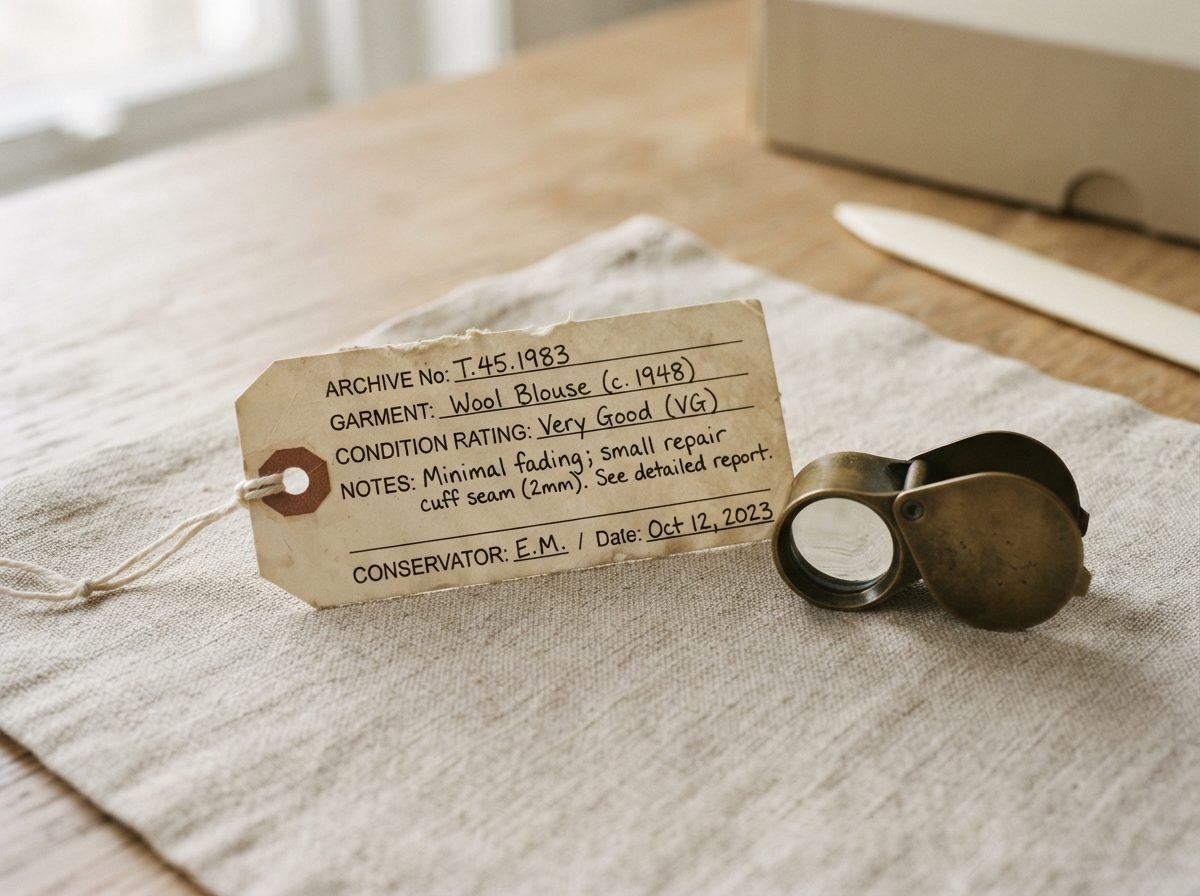
When a garment arrives at our table, the first thing we photograph is not the garment. It is the label. Before we look at the fabric, the stitching or the hardware, the label tells us whether the story we are about to write can be trusted.
Fibre content is a timeline
Textile labelling rules changed several times through the twentieth century, and each change left a trace. A garment that lists fibre percentages in a precise, regulated order is almost certainly post-1960. A piece with a plain woven label reading only the maker's name is likely to be older, and is a signal to look harder at construction.
Wool marks are the exception worth knowing. The Woolmark appeared in 1964 and its early forms had strict requirements on fibre purity. When we see a period-correct Woolmark on a coat, we treat the composition claim as verified rather than assumed.
Country of origin, and why it matters
Origin is not a marketing detail, it is a manufacturing fingerprint. A trench coat marked Made in England in the 1990s points to a small number of mills with known house styles. The same coat marked Made in Hong Kong tells a different story about the same decade, and often about a licensed production line.
Neither is automatically better. What matters is that the origin matches the construction. When they disagree, that is when we stop and investigate.
The care label tells you how it was expected to be worn
- Dry clean only usually means structured tailoring, and usually means the piece has held its shape better than a washable equivalent.
- Hand wash cold in a vintage piece often signals delicate silk or a knit that was never meant for a machine.
- A missing care label is normal on anything pre-1970s. Its absence is not evidence of a fake; the construction is what we authenticate on.
The label is a claim. The stitching is the evidence. We price on the evidence.
What we do with this
Every listing in the archive carries the maker, the origin and the era we can defend. When a label is missing or ambiguous, we say so in the condition notes rather than guessing. If you are buying elsewhere, read the label first, then put your hand inside the garment and look at the seams. That order will save you money.